Introduction
The @DataJpaTest annotation in Spring Boot is commonly used for testing JPA repositories in isolation. By default, it sets up an in-memory H2 database, but what if we want to test with a real database such as PostgreSQL without installing it locally?
This is where Testcontainers comes in.
What is Testcontainers?
Testcontainers is a Java library that allows running lightweight, disposable containers for databases, message queues, and other dependencies. It is particularly useful for integration testing as it provides:
✅ Real database testing without requiring local installation.
✅ Fresh database instances for each test execution.
✅ Automatic cleanup of containers after tests.
✅ Consistent testing environments across different machines.
Project Setup
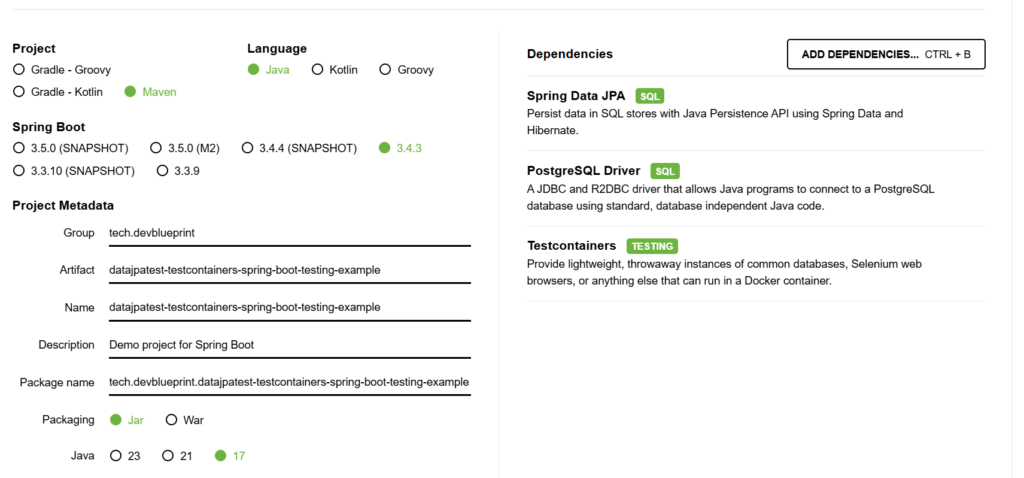
To get started, create a Spring Boot project with the following dependencies:
- Spring Data JPA – For database interaction.
- PostgreSQL Driver – To connect to a PostgreSQL database.
- Spring Boot Starter Test – Includes JUnit, AssertJ, and Mockito.
- Testcontainers – To run a PostgreSQL database in a Docker container.
Spring Boot Testing Libraries
The spring-boot-starter-test dependency provides several useful testing tools:
- JUnit – The core testing framework.
- Spring Test & Spring Boot Test – Utilities for integration and context-based testing.
- AssertJ – Fluent assertion library.
- Mockito – A mocking framework for unit tests.
- Testcontainers – Allows running a real PostgreSQL database in a container.
Implementation
1. pom.xml Configuration
To use Testcontainers with PostgreSQL, add the necessary dependencies to pom.xml.
File: pom.xml
<?xml version="1.0" encoding="UTF-8"?>
<project xmlns="http://maven.apache.org/POM/4.0.0" xmlns:xsi="http://www.w3.org/2001/XMLSchema-instance"
    xsi:schemaLocation="http://maven.apache.org/POM/4.0.0 https://maven.apache.org/xsd/maven-4.0.0.xsd">
    <modelVersion>4.0.0</modelVersion>
    <parent>
        <groupId>org.springframework.boot</groupId>
        <artifactId>spring-boot-starter-parent</artifactId>
        <version>3.4.3</version>
        <relativePath/> <!-- lookup parent from repository -->
    </parent>
    <groupId>tech.devblueprint</groupId>
    <artifactId>datajpatest-testcontainers-spring-boot-testing-example</artifactId>
    <version>0.0.1-SNAPSHOT</version>
    <name>datajpatest-testcontainers-spring-boot-testing-example</name>
    <description>Demo project for Spring Boot</description>
    <dependencies>
        <dependency>
            <groupId>org.springframework.boot</groupId>
            <artifactId>spring-boot-starter-data-jpa</artifactId>
        </dependency>

        <dependency>
            <groupId>org.postgresql</groupId>
            <artifactId>postgresql</artifactId>
            <scope>runtime</scope>
        </dependency>
        <dependency>
            <groupId>org.springframework.boot</groupId>
            <artifactId>spring-boot-starter-test</artifactId>
            <scope>test</scope>
        </dependency>
        <dependency>
            <groupId>org.springframework.boot</groupId>
            <artifactId>spring-boot-testcontainers</artifactId>
            <scope>test</scope>
        </dependency>
        <dependency>
            <groupId>org.testcontainers</groupId>
            <artifactId>junit-jupiter</artifactId>
            <scope>test</scope>
        </dependency>
        <dependency>
            <groupId>org.testcontainers</groupId>
            <artifactId>postgresql</artifactId>
            <scope>test</scope>
        </dependency>
    </dependencies>

    <build>
        <plugins>
            <plugin>
                <groupId>org.springframework.boot</groupId>
                <artifactId>spring-boot-maven-plugin</artifactId>
            </plugin>
        </plugins>
    </build>

</project>
2. Database Configuration
By default, Spring Boot expects a database connection in application.yaml. However, since we are using Testcontainers, we don’t need a static database URL. Instead, we dynamically provide connection properties in the test class.
3. Entity Definition
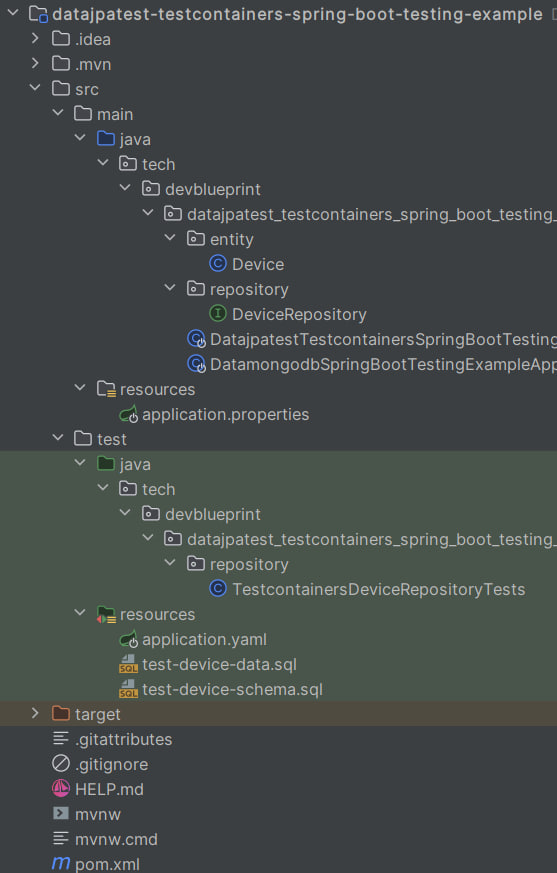
File: src/main/java/.../entity/Device.java
package tech.devblueprint.datajpatest_spring_boot_testing_example.entity;

import jakarta.persistence.*;

@Entity
@Table(name = "devices")
public class Device {

    @Id
    @GeneratedValue(strategy = GenerationType.IDENTITY)
    private Long id;

    private String name;

    private String type;

    private Double price;

    public Device() {
    }

    public Device(String name, String type, Double price) {
        this.name = name;
        this.type = type;
        this.price = price;
    }

    // Getters и Setters

    public Long getId() {
        return id;
    }

    public void setId(Long id) {
         this.id = id;
    }

    public String getName() {
         return name;
    }

    public void setName(String name) {
         this.name = name;
    }

    public String getType() {
         return type;
    }

    public void setType(String type) {
         this.type = type;
    }

    public Double getPrice() {
         return price;
    }

    public void setPrice(Double price) {
         this.price = price;
    }
}
4. Repository Interface
File: src/main/java/.../repository/DeviceRepository.java
package tech.devblueprint.datajpatest_spring_boot_testing_example.repository;

import tech.devblueprint.datajpatest_spring_boot_testing_example.entity.Device;
import org.springframework.data.jpa.repository.JpaRepository;
import org.springframework.data.jpa.repository.Query;
import java.util.List;
import java.util.Optional;

public interface DeviceRepository extends JpaRepository<Device, Long> {

    // Derived Query
    List<Device> findByType(String type);

    // JPQL-Query
    @Query("FROM Device d WHERE d.price > ?1")
    List<Device> findDevicesByPriceGreaterThan(Double price);

    // Native SQL-Query
    @Query(value = "SELECT * FROM devices WHERE name = :name", nativeQuery = true)
    Optional<Device> findByName(String name);
}
Writing Tests with Testcontainers
Using a PostgreSQL Container in Tests
With Testcontainers, we can dynamically start a PostgreSQL container and register its connection details for Spring Boot.
File: src/test/java/.../repository/TestcontainersDeviceRepositoryTests.java
package tech.devblueprint.datajpatest_testcontainers_spring_boot_testing_example.repository;

import org.junit.jupiter.api.Test;
import org.springframework.beans.factory.annotation.Autowired;
import org.springframework.boot.test.autoconfigure.orm.jpa.DataJpaTest;
import org.springframework.test.context.DynamicPropertyRegistry;
import org.springframework.test.context.DynamicPropertySource;
import org.springframework.test.context.jdbc.Sql;
import org.testcontainers.containers.PostgreSQLContainer;
import org.testcontainers.junit.jupiter.Container;
import org.testcontainers.junit.jupiter.Testcontainers;
import tech.devblueprint.datajpatest_testcontainers_spring_boot_testing_example.entity.Device;

import java.util.Optional;

import static org.assertj.core.api.Assertions.assertThat;

@Testcontainers
@DataJpaTest
@Sql({"/test-device-schema.sql"}) // Execute the schema creation script
public class TestcontainersDeviceRepositoryTests {

    // Start PostgreSQL container using Testcontainers
    @Container
    public static PostgreSQLContainer<?> postgresContainer = new PostgreSQLContainer<>("postgres:16.3")
            .withDatabaseName("testdb")
            .withUsername("postgres")
            .withPassword("root");

    // Dynamically register properties so that Spring Boot uses the container's JDBC URL and credentials
    @DynamicPropertySource
    static void registerProperties(DynamicPropertyRegistry registry) {
        registry.add("spring.datasource.url", postgresContainer::getJdbcUrl);
        registry.add("spring.datasource.username", postgresContainer::getUsername);
        registry.add("spring.datasource.password", postgresContainer::getPassword);
    }

    @Autowired
    private DeviceRepository deviceRepository;

    // Test using Testcontainers to verify that the repository works with the PostgreSQL container
    @Test
    @Sql({"/test-device-data.sql"}) // Execute the test data insertion script
    public void testFindByName_UsingTestcontainers() {
        Optional<Device> deviceOpt = deviceRepository.findByName("iPhone 13");
        assertThat(deviceOpt).isPresent();
        Device device = deviceOpt.get();
        assertThat(device.getName()).isEqualTo("iPhone 13");
        assertThat(device.getType()).isEqualTo("Smartphone");
        assertThat(device.getPrice()).isEqualTo(999.99);
    }
}
Key Annotations Explained:
@Testcontainers– Enables Testcontainers integration.@Container– Defines a PostgreSQL container that runs for the duration of the test class.@DynamicPropertySource– Registers the container’s JDBC URL and credentials dynamically.@DataJpaTest– Loads only JPA-related components for testing.@Sql("/test-device-schema.sql")– Runs the schema creation script before tests.@Sql("/test-device-data.sql")– Loads test data before each test.
Understanding Transactions in @DataJpaTest
By default, tests annotated with @DataJpaTest run in transactions and automatically roll back at the end of each test. This ensures that each test starts with a clean database state.
However, if you need to disable transaction management, use @Transactional(propagation = Propagation.NOT_SUPPORTED), as shown below:
@DataJpaTest
@Transactional(propagation = Propagation.NOT_SUPPORTED)
public class StudentRepositoryTests {

    @Autowired
    private StudentRepository studentRepository;

    @Test
    void findByName_ReturnsTheStudent() {
        // Test logic...
    }
}
This is useful when testing database operations that require commits, such as stored procedures or triggers.
Example SQL Scripts
SQL scripts should be placed in src/test/resources so that Spring Boot can automatically load them during test execution.
Schema Definition
File: src/test/resources/test-device-schema.sql
CREATE TABLE devices
(
    id    INT AUTO_INCREMENT PRIMARY KEY,
    name  VARCHAR(255) NOT NULL,
    type  VARCHAR(100),
    price DOUBLE
);
Test Data Insertion
File: src/test/resources/test-device-data.sql
INSERT INTO devices (id, name, type, price)
VALUES (1, 'iPhone 13', 'Smartphone', 999.99),
       (2, 'Galaxy S22', 'Smartphone', 899.99),
       (3, 'Dell XPS 13', 'Laptop', 1199.99),
       (4, 'MacBook Pro', 'Laptop', 1999.99);
Conclusion
In this guide, we explored how to use Testcontainers with @DataJpaTest to test JPA repositories with a real PostgreSQL database.